NEST (Nordic–Lund Emerging Scholars Teaching Programme in Korean Studies) supports early-career Korea-focused scholars by providing opportunities to develop teaching experience and strengthen research networks across the Nordic region.
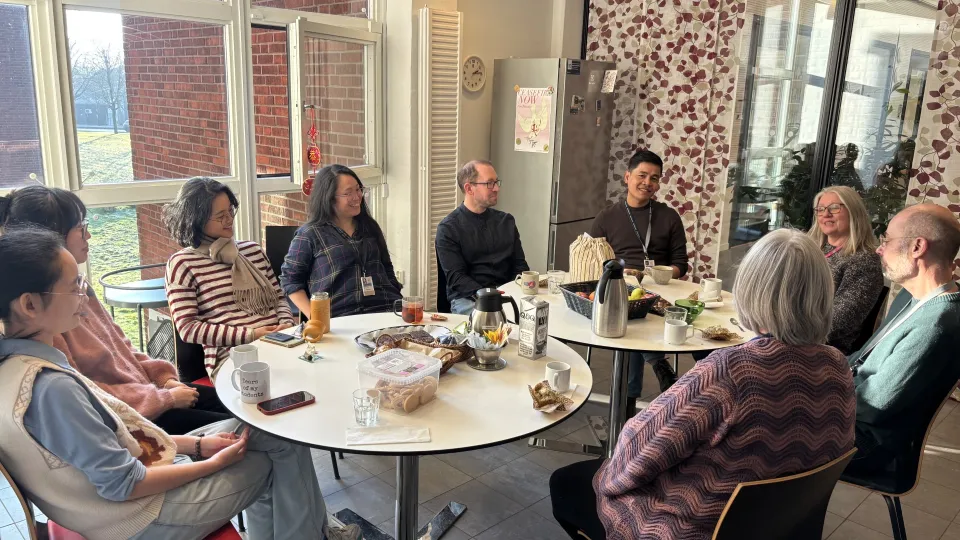
Our first NEST Scholar has just arrived and will be with us for the next three weeks. Below is a short interview with her.

Can you briefly introduce yourself and your research?
Hello! My name is Minyoung Kim. I’m currently a lecturer at Yonsei University. I earned my Ph.D. in Sociology from the University of California, Irvine in 2024.
My research uses in-depth interviews and ethnographic methods to examine how individuals transform into social movement actors and sustain that participation long-term. I sit at the intersection of gender, emotions, and disaster studies. Specifically, my work looks at how bereaved families transition their personal grief to collective engagement for systemic social change in contemporary South Korea.
My research has been published in the Journal of Korean Studies, Sociological Perspectives, and Situations: Cultural Studies in the Asian Context.
What will you be teaching during your time here?
I will be engaging with students through class activities and a guest lecture.
In class, I will deliver a lecture on post-disaster activism in South Korea and Japan. We will explore the gendered dynamics of social movements, specifically focusing on motherhood. The lecture will examine the challenges and strengths women often find while partaking in activism in the name of mothers.
For the public lecture, I will present one of the burgeoning research topics: the 2024 anti-martial law protests in South Korea. I am analyzing the strikingly festive and entertaining nature of the protests. Based on in-depth interviews with protesters in their 20s and 30s, who have emerged as a new generation of political actors, I will discuss the complex affects that underlie their concert-like political actions.
Beyond lecturing, I also look forward to working directly with scholars and students at Lund, leading a workshop on academic writing in the social sciences and participating the centre’s research seminar as discussant.
How do you hope your time in the NEST program will support your academic journey?
I am honored to serve as the first NEST scholar. This opportunity comes at a pivotal moment in my early career, as I transition from wrapping up my dissertation to launching a new research project.
Since I began teaching last year, the classroom has become my most rewarding space. While I love teaching sociology at Yonsei University, I am eager to broaden my pedagogical horizon by communicating with students and researchers in a new international context—Nordic countries .
In this context, I am especially excited to engage with colleagues and students in Asian Studies at not only Lund University but also Turku University. Presenting both my completed dissertation and my new project on the 2024 protests to this informed audience will provide me with fresh perspectives that I cannot get back home.
What are you most excited to experience or try during your stay in Sweden?
As this is my first visit to Sweden, I am most excited to experience the unique campus culture of Lund. My academic journey has taken me through Korean and American universities, so stepping into Lund’s historic landscape—with its cobblestones and centuries of tradition—feels very special.
I am excited to be staying at one of Europe’s most historic and prestigious universities. I look forward to immersing myself in the city's 'medieval vibe' and beautiful architecture. I believe this inspiring atmosphere will be the perfect backdrop for building lasting relationships with my new colleagues. I see this as just the beginning of our connection, and I hope to eventually welcome my new Lund colleagues to Seoul in the future!
Do you have any advice for those considering a PhD or currently navigating their PhD journey?
A PhD is a major decision because it is not just about earning a degree, but about learning how to sustain a life as an academic. Along the way, you will inevitably face uncertainty and periods where you don’t seem to have tangible progress.
If you ever doubt your ability to finish, my answer is: yes, you can. The key is to allow yourself the space to explore both the world and your own potential. Treat your PhD as a journey where every step matters, rather than a race to the finish line. Ultimately, the degree is only the beginning; those who learn to value the process will thrive not just during the program, but throughout the academic life that follows.
Her public lecture, Mourning, Resistance, and Festivity: “Disaster Generation” and Protest Affect in South Korea, will take place on 4 February (15:15–17:00) and is open to all. Everyone is welcome to join.
Dr. Minyoung Kim can be reached at my [dot] kim [at] yonsei [dot] ac [dot] kr (my[dot]kim[at]yonsei[dot]ac[dot]kr).
This program is generously sponsored by:
